Prince of Disks
Air of Earth
The Prince of the Chariot of Earth
Rider-Waite: Knight of Pentacles
Air of Earth: thought applied to matter, the steady engineer, slow to start and hard to stop.
| Formula | Air of Earth: Prince is Air, Disks are Earth |
|---|---|
| Mix | Opposed elements, an unstable, high-tension mix |
| Letters | Vau of Heh final (the Name, YHVH) |
| Sephirah | Tiphareth, sphere of the Princes |
| Arc | 21° Aries to 20° Taurus |
| Dates | Apr 11 – May 10 |
| Rules | Four of Wands (Completion), Five of Disks (Worry), Six of Disks (Success) |
| I Ching | Hexagram 53, Chien, Development (Wind over Mountain) |
| Rider-Waite | Knight of Pentacles |
In a reading
Energetic, enduring, a steady worker, a competent manager, patient, industrious, thoughtful in practical matters; the engineer of the deck. Badly placed: slow, stupid, unenlightened, hollow, blind to anything he cannot use.
Working with the card
| As a person | A capable, thoughtful, dependable manager of practical affairs. |
|---|---|
| As a situation | A project that needs planning and steady execution. |
| Advice | Apply your mind to the material and keep going. |
| Do | Plan it, then build it methodically. |
| Bring | Competence, perseverance, good planning. |
| Beware | Stolidity, insensitivity, resentment of quicker people. |
| Ask | What is the most practical way to do this? |
Correspondences
- Prince Vau, Air
- Disks Heh final, Earth
- Air of Earth rank of suit
- Tiphareth sphere of the Princes
- Yetzirah the world of formation
- 21° Aries to 20° Taurus Apr 11 – May 10
- ♈︎Aries
- ♉︎Taurus
- Aries III Four of Wands
- Taurus I Five of Disks
- Taurus II Six of Disks
- Hexagram 53 Chien, Development (Wind over Mountain)
- Earth colour element
On the card
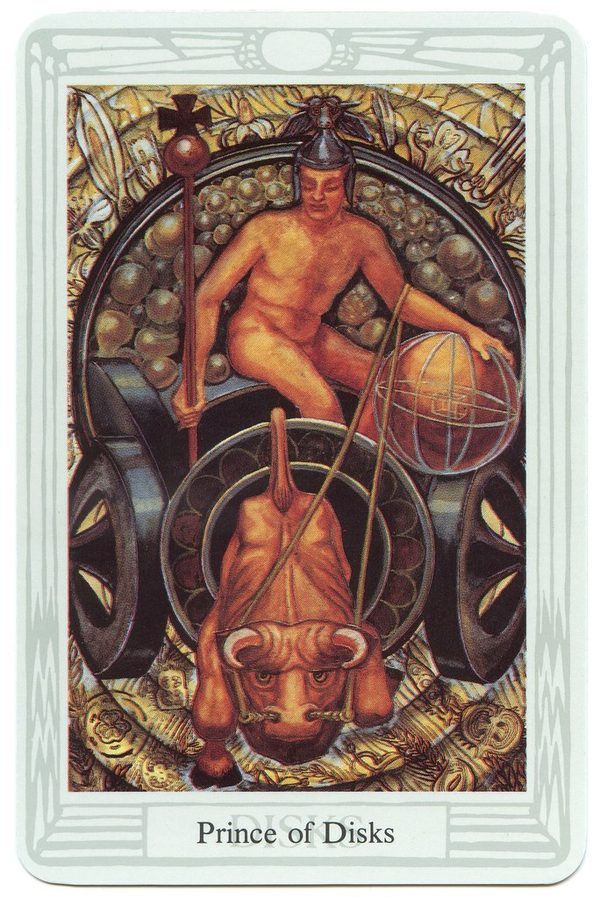
A naked prince with a bull's head crest rides a chariot drawn by a bull through a field of flowers and fruit, holding a globe in one hand and an orbed sceptre in the other.
Kabbalah and astrology
The Vau of the final Heh: Air of Earth, mind applied to matter, the intelligence of the builder. He rules the last decan of Aries (the Four of Wands) and the first two of Taurus (the Five and Six of Disks). Crowley's hexagram, 53, Development, is the tree growing slowly on the mountain.
Rules Four of Wands (Aries III, Venus), Five of Disks (Taurus I, Mercury), Six of Disks (Taurus II, The Moon). The courts of the twelve arcs each take the last decan of one sign and the first two of the next, so that every court contains a hidden tension between two signs.
I Ching
Crowley builds each court's hexagram from two trigrams, the suit below and the rank above: Disks give Mountain, Princes give Wind. The result is hexagram 53, Chien, Development (Wind over Mountain). See I Ching and the courts.
Depth psychology
Sensation carried by thought: the practical intelligence that understands how things work. As an inner figure, the animus as maker. The four ranks are often read as the four ways the suit's function can be lived: the Knight extraverted and initiating, the Queen introverted and sustaining, the Prince as its intellectual form, the Princess as its embodied form.
Thoth and Rider-Waite
This card corresponds to the Rider-Waite Knight of Pentacles. Crowley renamed the ranks to follow the letters of the Name: Knight (Yod), Queen (Heh), Prince (Vau), Princess (final Heh), so that the Thoth Knight is the Waite King and the Thoth Prince the Waite Knight. The figures' mounts follow the Golden Dawn: Knights on horses, Queens on thrones, Princes in chariots, Princesses on foot.
The two signs
Aries (“I am”): courage, initiative, honesty, energy, independence. Shadow: impulsiveness, selfishness, anger, starting fights and projects without finishing them.
Taurus (“I have”): patience, loyalty, sensuality, steadiness, practical skill, love of beauty. Shadow: stubbornness, possessiveness, laziness, materialism, resistance to change.
The card holds the last ten degrees of Aries and the first twenty of Taurus, so its character is mostly Taurus with a trace of the sign before. Anyone born Apr 11 – May 10 has this as their court card. Find a birthday.
Related cards
Cards ruled
- ♀︎Four of Wands CompletionAries III, Apr 11–20
- ☿︎Five of Disks WorryTaurus I, Apr 21–30
- ☽︎Six of Disks SuccessTaurus II, May 1–10
Trumps of Aries and Taurus
The other Princes
- ♋︎Prince of Wands Air of FireAir of Fire
- ♎︎Prince of Cups Air of WaterAir of Water
- ♑︎Prince of Swords Air of AirAir of Air
The court of Disks
Correspondences follow the Golden Dawn system as used in Crowley's Book of Thoth and Liber 777. Paintings by Lady Frieda Harris, © Ordo Templi Orientis. Where sources differ.